Favorite Comets
This page contains my favorite comet photos. They are not always the best photos or the brightest comets, but these are the ones that are special to me. They are arranged oldest to newest.
Comet West in Pegasus - Mar. 6, 1976
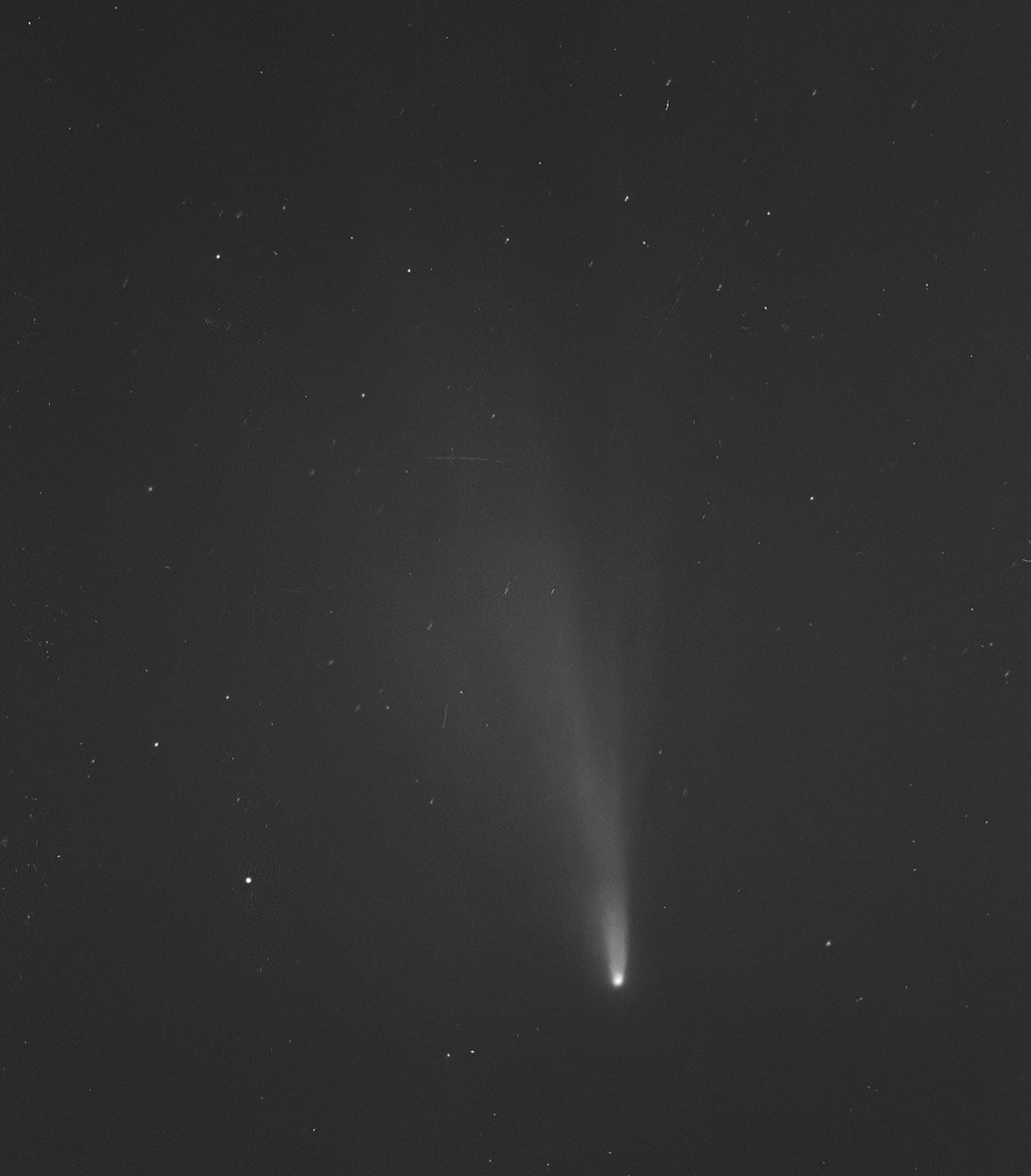
C/1975 V1 (West). This is my first comet photo. It was taken off Kildaire Farm Road in Cary
before sunrise. I was using my father's 35mm Yashica camera with a 205mm lens and
Kodak Tri-x black and white film. If I had only had a driven telescope mount at the time, this
photo would have been really neat. The bright star left of the comet is Enif in
Pegasus. The tail is roughly 5 degrees long in this photo. At the time, Comet West visually
was the best comet I had ever seen.
I had just graduated from N.C. State University in Raleigh where
I had taken a photography course. I developed the film and printed the photo myself at home.
This photo is a scan of the print I made.
It was touched up some in 2026 using the PixInsight tools listed below.
Details:
Location: Kildare Farm Rd. Cary, NC
Camera: Yashica 35mm film camera
Exposure: not recorded
Filter: none
Scope: 205mm camera lens
Mount: camera tripod
Guider: none
Capture software: none
Guiding software: none
Calibration frames: none
Processing software: Pixinsight, BlurXterminator, NoiseXterminator, Affinity Photo.
Weather conditions: Not noted
Notes: My brother Alex was with me during this session.
He was in some of the wide angle shots I also took.
Back to the top of the page
Back to Mark's Astrophotography Home
Comet Halley in Sagittarius Mar. 22, 1986
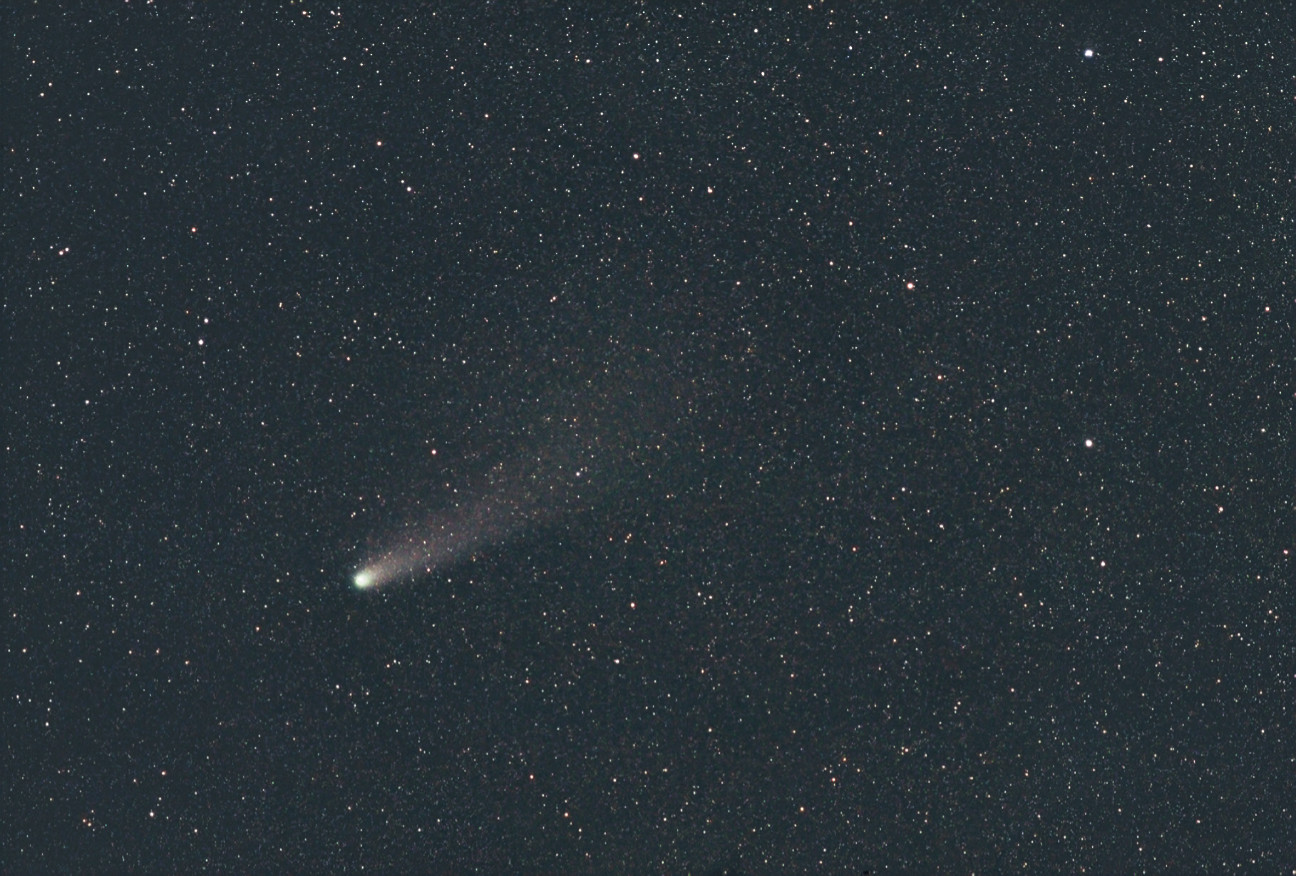
1P/Halley on March 22, 1986. After a scheduled public observing session
at the WRAL soccer fields, I headed to a nearby dark site and photographed
Comet Halley with my Olympus OM-1 and a 135mm lens.
The camera was riding piggy-back on my fork mounted C-11.
I used KodaColor VR-1000 print film.
The brighter stars in the
upper right of the photo are part of the handle of the teapot of Sagittarius.
My notes said a 3 degree tail was visible naked eye.
This photo came from a scan of the 35mm negatives.
It was grainy and had some gradient
problems that were cleaned up with Pixinsight and Affinity photo.
Details:
Location: Eastern Wake County, NC
Camera: Olympus OM-1 35mm film camera
Exposure: not recorded
Filter: none
Scope: Olympus 135mm f/2.8 camera lens
Mount: C-11 telescope
Guider: none
Capture software: none
Guiding software: none
Calibration frames: none
Processing software: Pixinsight, BlurXterminator, NoiseXterminator, and Affinity Photo.
Weather conditions: Not noted
Notes: none
Back to the top of the page
Back to Mark's Astrophotography Home
Comet Hyakutake in Bootes - Mar. 23, 1996
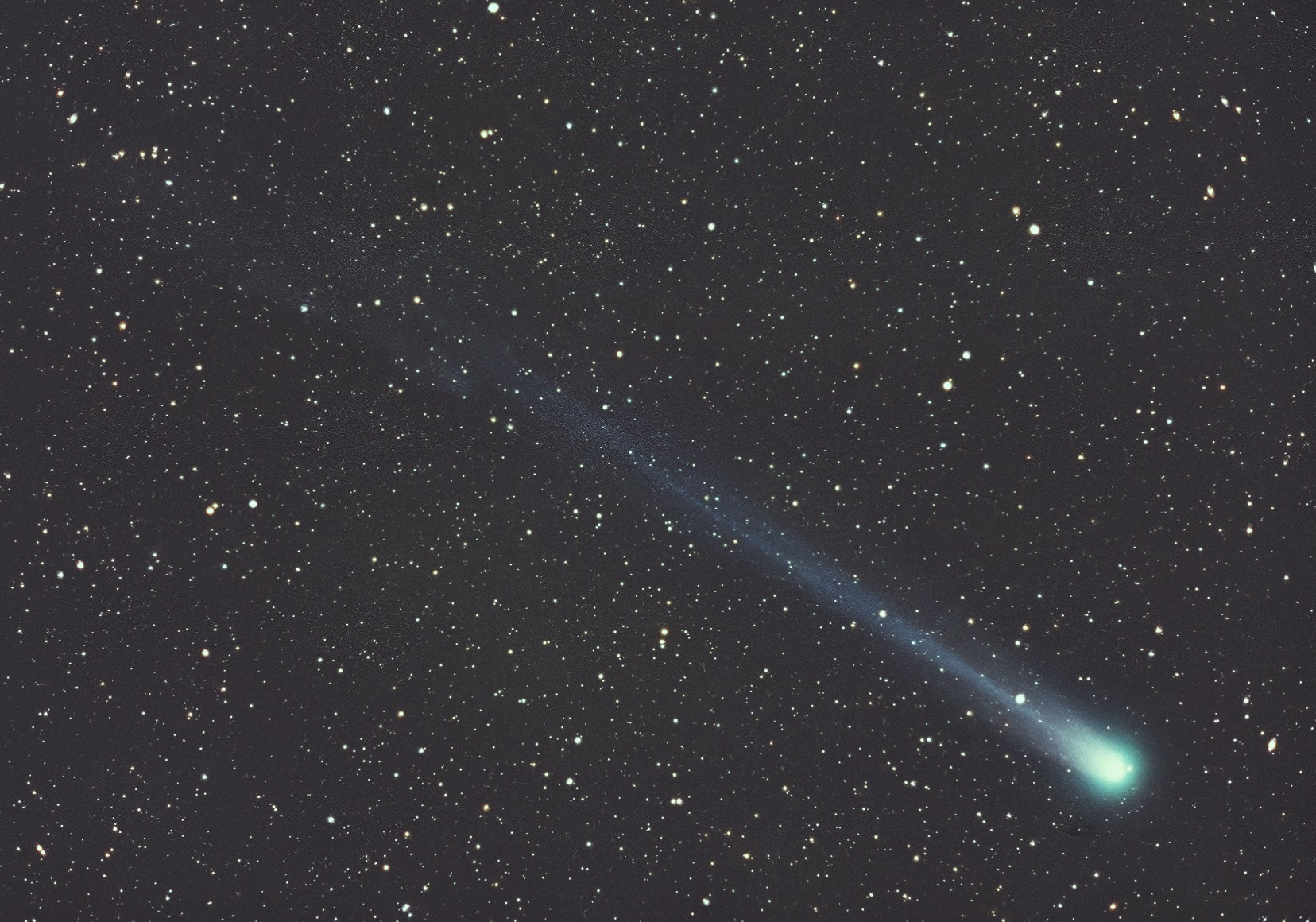
C/1996 B2 (Hyakutake) -
This was a beautiful comet with a bright nucleus that reached 0 magnitude,
and a tail that reached as long as 35 degrees.
Visually tonight, in the nucleus there was a sharp spike that looked like a mini comet.
The motion of this comet was incredible.
Motion past a star at 88x in the C-11 was easily seen.
We could see the comet tail naked eye at 14 degrees long.
While observing, the camera was riding piggyback on my C-11 scope.
This photo is a scan of one of the color slides that night.
Details:
Location: New Hope Overlook at Jordan Lake, NC
Camera: Olympus OM-1 35mm film camera with Scotchchrome ASA 400 color slide film
Exposure: between 5 and 10 minutes
Filter: none
Scope: Olympus 35mm f/1.8 camera lens
Mount: C-11 telescope
Guider: none
Capture software: none
Guiding software: none
Calibration frames: none
Processing software: Pixinsight, BlurXterminator, NoiseXterminator, and Affinity Photo.
Weather conditions: Not noted
Notes: none
Back to Mark's Astrophotography Home
Comet Hale-Bopp in Andromeda - Mar. 16, 1997
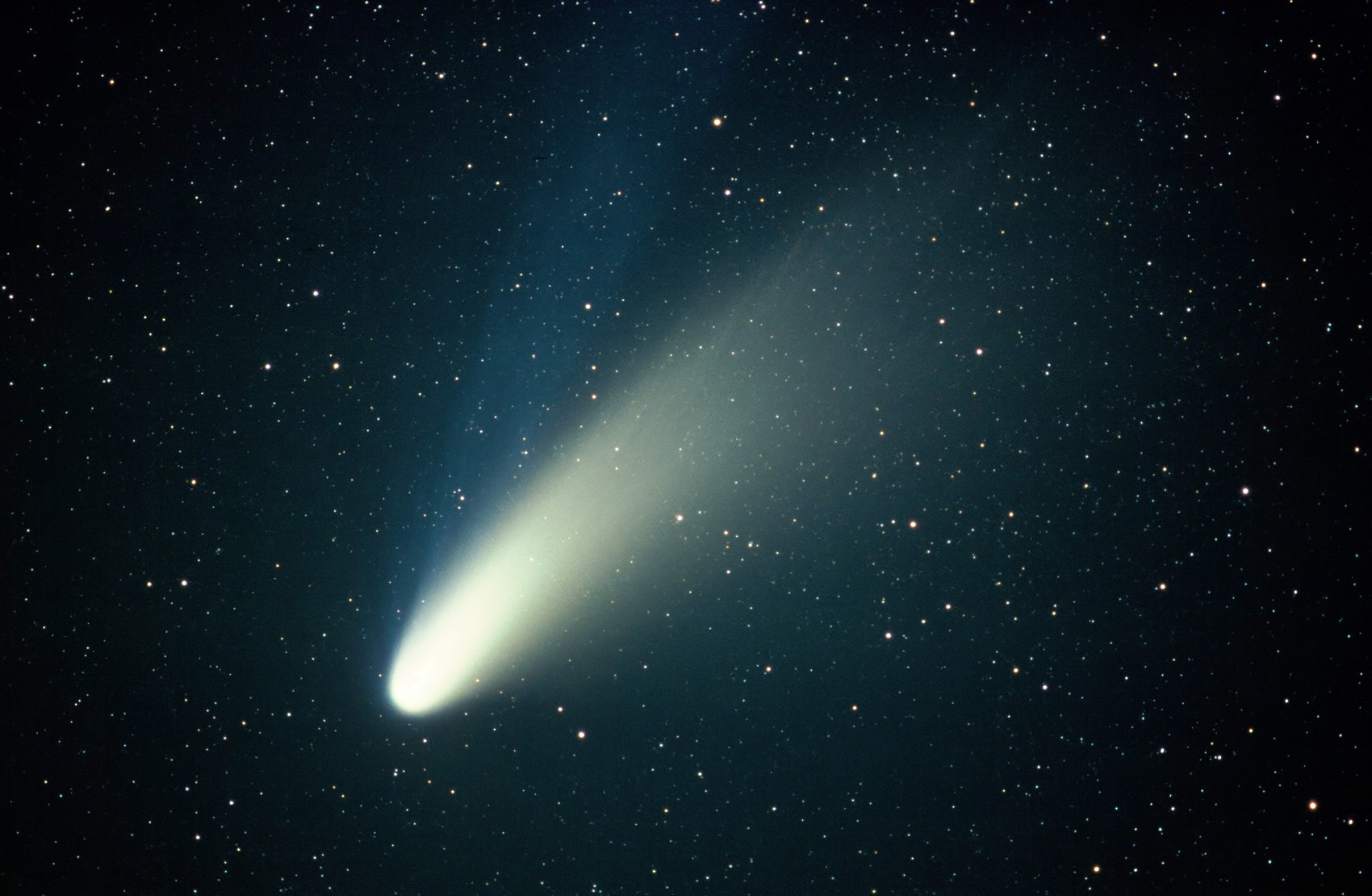
C/1995 O1 (Hale-Bopp) taken in the early morning hours of March 16, 1997.
Hale-Bopp was probably the best comet I have ever seen.
I started observing it in June of 1996 and made my last observations in May of 1997.
In my log entry of Mar. 9, 1997 I made note that one side of the coma was brighter than the other,
and it had three concentric arcs that reminded me of shock waves.
The dust tail was very bright around 8-10 degrees long visually.
There was a point like nucleus.
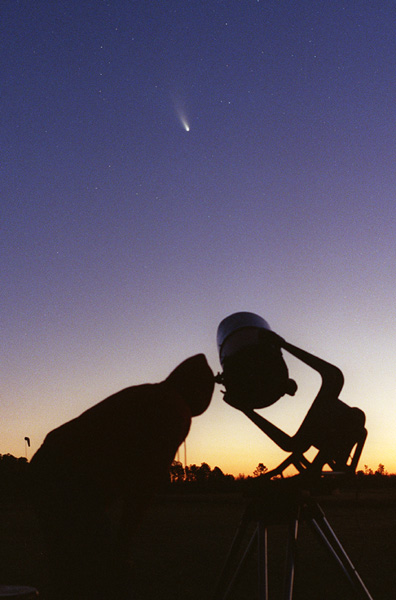
Here is a shot of me observing the comet with my C-11 at dawn that morning.
Photo by Johnny Horne. This shot was published in the Fayetteville Observer and
the Raleigh News and Observer.
My camera was riding piggyback underneath the C-11 in this shot.
Details:
Location: Hayfield near Fayetteville, NC
Camera: Nikon 35mm FM2
Exposure: single 6 minute exposure Elite II ASA 400 slide film
Filter: none
Scope: Nikon 300mm f/4.5
Mount: Losmandy G-11
Guider: none
Capture software: none
Guiding software: none
Calibration frames: none
Processing software: Pixinsight, BlurXterminator, NoiseXterminator, and Affinity Photo.
Weather conditions: Not noted
Notes: The original slide was scanned then modified with PixInsight, etc
Back to the top of the page
Back to Mark's Astrophotography Home
Triple Comet 73P/Schwassmann-Wachmann 3 - Apr. 18, 2006
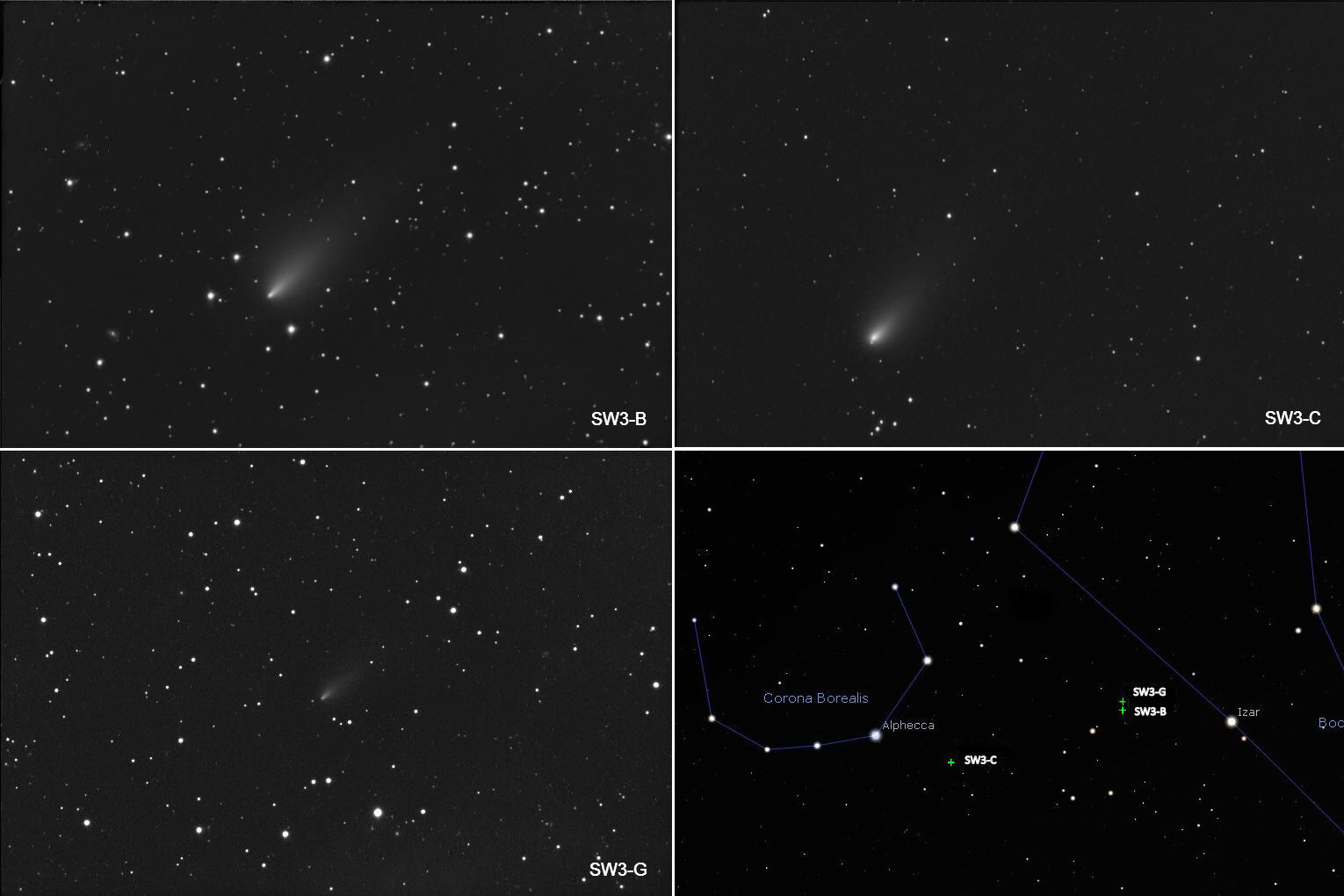
This was a rare and very exciting night for me.
I was able to image three fragments of Comet Schwassmann-Wachmann 3 (SW3) in
one night during the span from 10:30 to midnight.
I was out at Bigwoods using my Televue Genesis 4" scope and SBIG-ST-402me CCD camera.
Each comet was captured for 10 minutes using 10 x 60s subs unguided.
The size of each individual image is about the same as the full moon.
In my image above, I mosaiced the 3 brightest fragments and a finder chart into 1 photo.
The finder chart shows where the comets were that night in relation to each other.
It is interesting how far each fragment has moved away from the others since 1995.
I reccommend clicking on the photo which will bring it up to full size
in a new window.
Hovering over the new window should show a plus sign which will enlarge the photo
to its largest size.
Once enlarged, it will be much easier to see the finder chart located the bottom right corner.
Comet SW3 was discovered in May of 1930 in Germany. It has a 5.44 year orbital period.
When SW3 returned in Sept. 1995, it started breaking up into 4 large pieces.
When it returned for its May 2006 visit, it broke into 66 separate fragments.
In April, 2006 when my photos were taken, the Hubble Space Telescope took a photo
showing fragments B and G breaking into dozens of fragments.
Fragment C seems to be the largest fragment and the main component of the original comet.
The orbital period of the fragments now range from 4.7 to 6.1 years.
Here is a link to a cool NASA video that shows the breakup of fragment B:
Breakup video
Back to the top of the page
Back to Mark's Astrophotography Home
Comet Holmes in Perseus - Oct 28, 2007
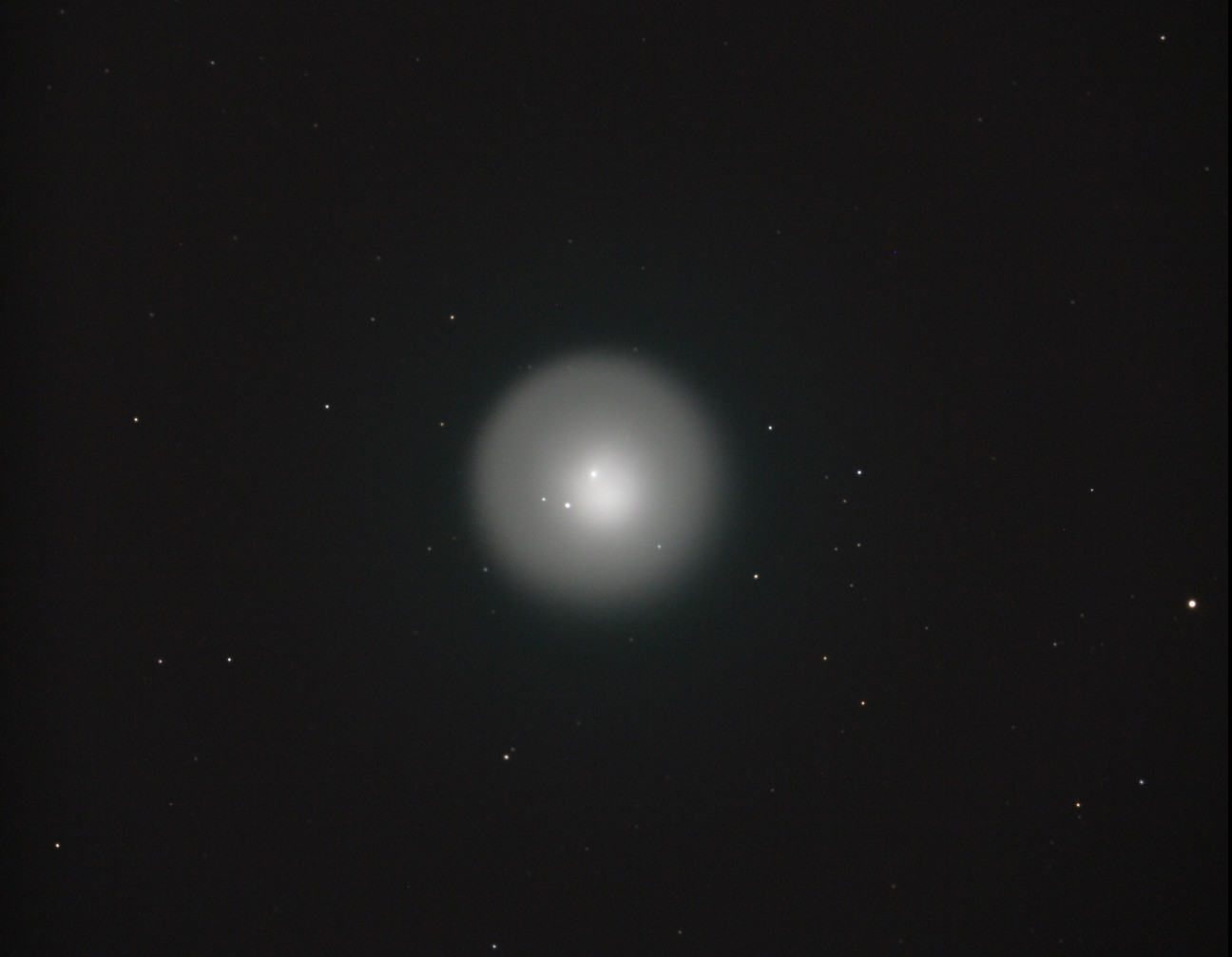
Comet 17P/Homes - Taken Oct. 28, 2007. During October 2007 Comet
Holmes unexpectedly brightened among the stars of Perseus.
It stayed bright for two months.
This shot was taken with my C-11 @f/6.3 when the coma was still small.
I used my unmodified Canon Rebel XT to acquire the images.
Even though it doesn't look like it, this shot is in color.
The comet was visible by eye in the NE sky from our house.
There is no tail on this comet, only a large coma.
The brightest dot at the middle is the nucleus (central condensation)
and two stars are to its lower left.
North is up in this view. The frame is 30 arc minutes wide,
so the comet is about 6 arc minutes in diameter.
Click on the image for a larger view in a new window.
Details:
Location: Front yard, Cary NC
Camera: Canon Rebel XT
Exposure: single 20 sec at ISO 400
Filter: none
Scope: Celestron C-11 SCT (11" @ f/6.3)
Mount: Losmandy G-11
Guider: none
Capture software: none
Guiding software: none
Calibration frames: none
Processing software: Pixinsight, BlurXterminator, Affinity Photo.
Weather conditions: Not noted
Notes: The original image was rotated 90 degrees and cropped.
Back to Mark's Astrophotography Home
Comet ISON in Virgo - Nov. 8, 2013
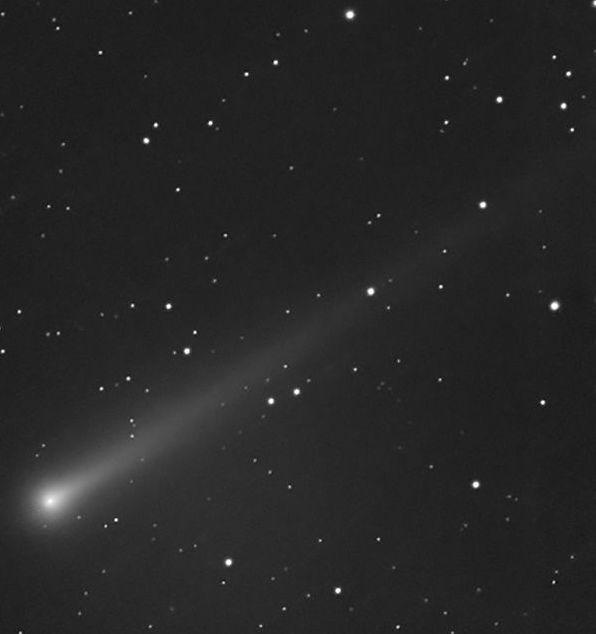
C/2012 S1 (ISON) taken on 11/08/2013 at 5:30 am from Cary, NC.
ISON was predicted to be a very bright sungrazing comet.
The problem was as it approached the sun in late November, it disintegrated.
It looked pretty good in photographs before its demise.
Visually, we could not see the comet through the Genesis at 25x.
Low altitude and lots of light pollution hampered the visual effort.
We were looking almost directly over a street light.
Details:
Location: Front yard Cary, NC
Camera: SBIG ST-402
Exposure: 15 x 30s
Filter: UV/IR
Scope: TeleVue Genesis 4" f/5
Mount: Losmandy G-11
Guider: None
Capture software: MaximDL 5
Guiding software: none
Calibration frames: darks, flats, flat-dark
Processing software: Pixinsight
Weather conditions: not noted
Notes: This image was re-processed with PixInsight in June 2024.
Back to the top of the page
Back to Mark's Astrophotography Home
Comet Lovejoy C/2014 Q2 in Taurus - Jan. 10, 2015
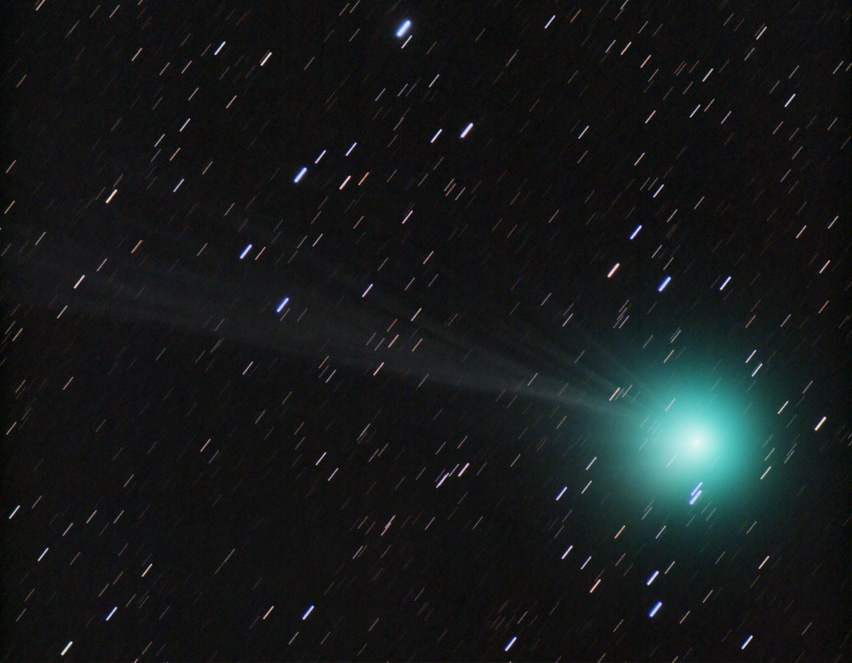
Comet Lovejoy taken on Jan. 10, 2015 through my Genesis 4" f/5 refractor at the Bigwoods site.
The night was frigid for central NC with the temperature at time of image capture
of about 21 degrees.
The comet seemed to be around magnitude 4 which made it visible to the naked eye,
but no tail was seen naked eye.
The tail structure in the photo is quite interesting showing multiple streamers.
This is a cropped view showing only the area around the coma and inner tail.
The left to right area covers around 1.25 degrees in this cropped image. North is up.
The image was aligned on the comet during it's northward movement causing the streaked stars.
Details:
Location: Bigwoods site Jordan Lake, NC
Camera: Digital Rebel
Exposure: 13 x 60s
Filter: UV/IR
Scope: TeleVue Genesis 4" f/5
Mount: Losmandy G-11
Guider: None
Capture software: Backyard EOS
Guiding software: none
Calibration frames: darks, flats, flat-dark
Processing software: Pixinsight
Weather conditions: Cold 21F
Notes: This image data was re-processed with PixInsight in June 2024.
Back to the top of the page
Back to Mark's Astrophotography Home
Comet C/2020 F3 NEOWISE - July 10, 2020
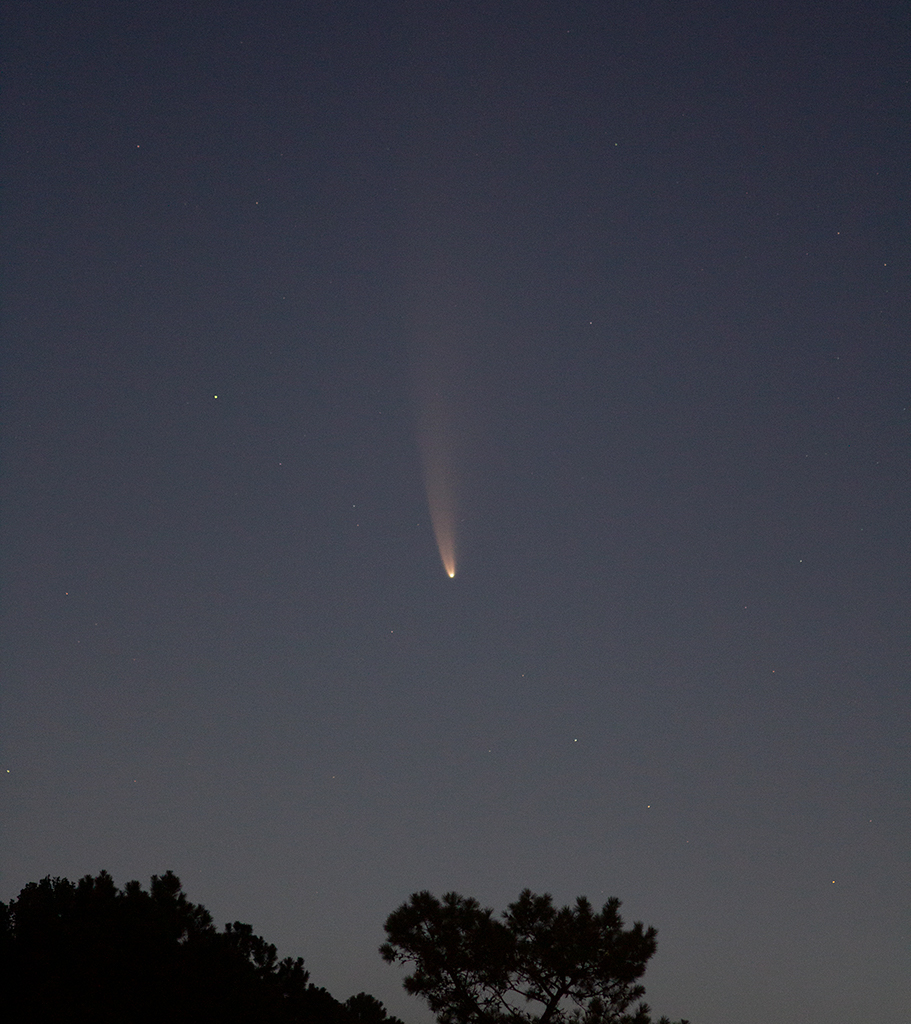
Comet C/2020 F3 (NEOWISE) rising in the northeast approximately 5am.
This was taken on the dam at Crabtree Lake in Cary, NC.
We noticed the tail rising above the treeline before we ever saw the nucleus.
It was an amazing sight.
The comet was visible to the naked eye, but binoculars provided a really nice view.
We followed the comet until the sky became too bright due to morning twilight.
I used a tripod mounted Canon T3i and a Nikkor 180mm f/2.8 lens wide open.
The exposure was 0.7 second at ISO 1600.
The frame was cropped at the top and bottom.
Back to the top of the page
Back to Mark's Astrophotography Home
Comet C/2022 E3 ZTF, Jan. 24, 2023
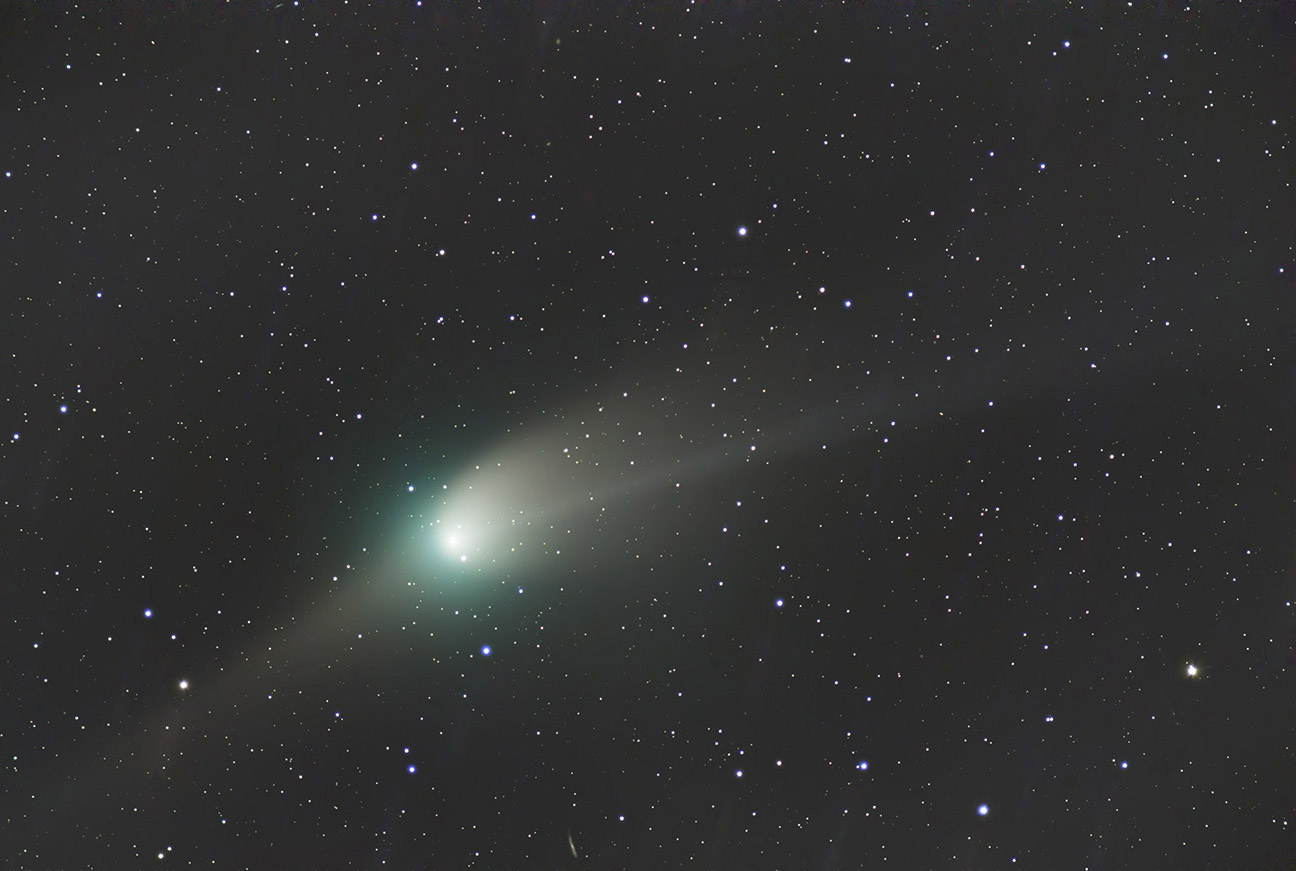
Comet C/2022 E3 (ZTF) was zooming through the constellation Draco Tuesday morning between 4:22 and
5:32. 56 x 60 second exposures were combined together in two sets to produce this image.
One set of images was aligned to the stars and one set was aligned to the comet and the two
sets were combined together.
There are three tails visible in this photo.
The anti-tail points to the lower left.
The ion tail is the faint thin tail pointing upper right to the edge of the frame.
The broad dust tail also points to the upper right.
Note the small edge on spiral galaxy NGC 5894 (mag. 13.0) below the comet head on the edge of the frame.
The field of view of the photo is approx. 2 x 1.4 degrees. The comet is pretty big.
North is at the top.
Click on the image for a larger view in a new window.
Details:
Location: Front yard Cary, NC
Camera: ASI294mc-Pro
Exposure: 56 x 60s gain 150
Filter: UV/IR
Scope: Televue Genesis 4" f/5 refractor
Mount: iOptron GEM-45
Guider: Orion 60mm finder/guider
Capture software: ZWO ASIair Plus
Guiding software: ZWO ASIair Plus
Calibration frames: darks, flats, flat-dark
Processing software: Pixinsight, Photoshop CC
Weather conditions: Very clear and cold temp about 31F
Notes: The photo displayed is a slight crop of the original frame.
Back to Mark's Astrophotography Home
Comet C/2023 A3 Tsuchinshan-ATLAS - Oct. 14, 2024
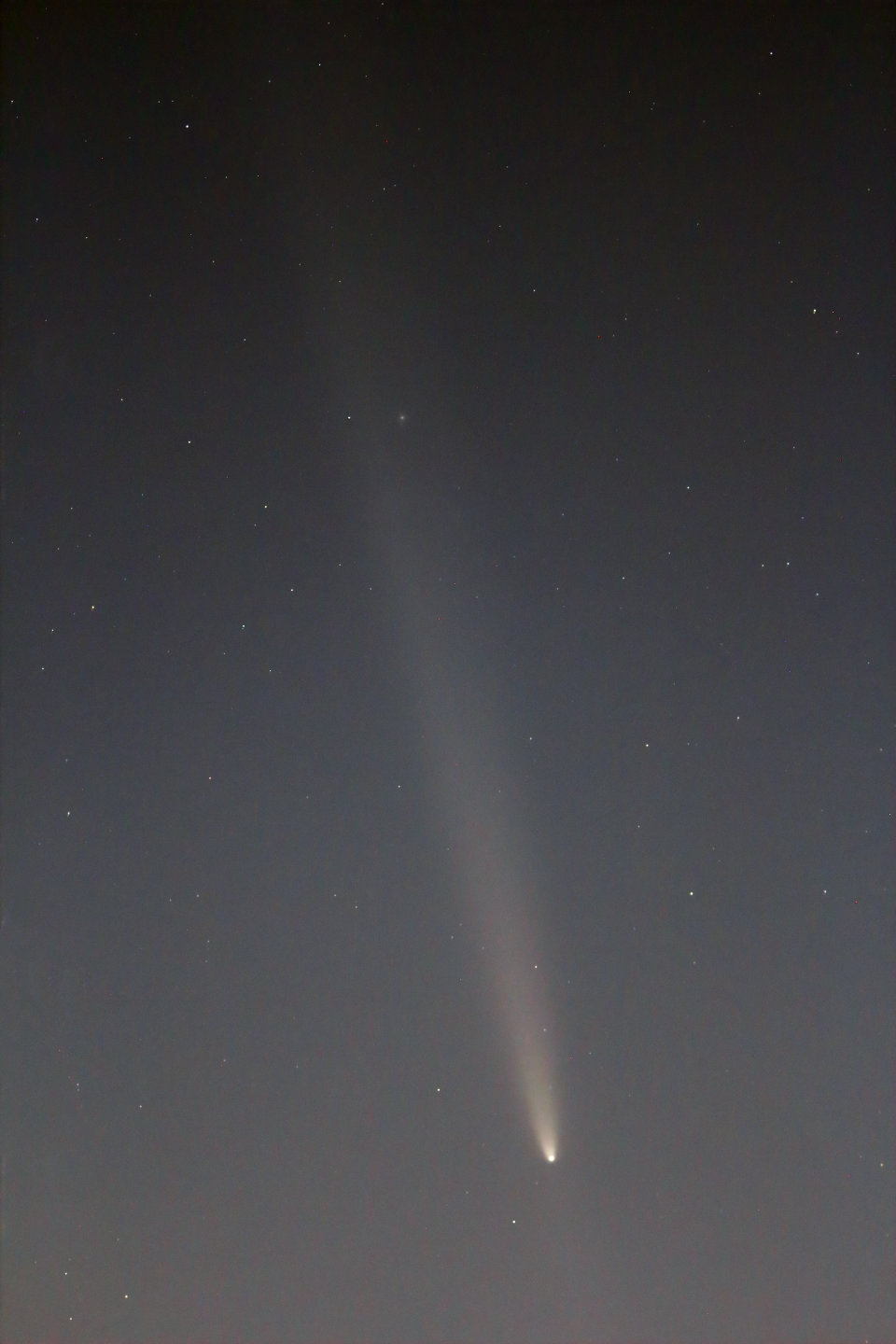
Comet C/2023 A3 looked much better tonight from my light polluted area.
I was at the Crabtree Lake Dam which was busy with other comet chasers and the usual hikers
and bikers.
A cold front came though today clearing out the high clouds and haze.
Even with better conditions, I could not see A3 naked eye,
but was able to find it in binoculars so I could point my camera.
A careful look at the photo will show a hint of the anti-tail that has formed as well
as globular cluster M5 embedded in the tail near the top.
Details:
Location: Crabtree Lake Dam, Cary, NC
Camera: Canon Rebel T3i with Nikon 135mm f/3.5 lens
Exposure: Single 3 second exposure at ISO 800
Filter: none
Scope: none
Mount: camera tripod
Guider: none
Capture software: none
Guiding software: none
Calibration frames: none
Processing software: PixInsight and Affinity Photo
Weather conditions: Cool and mostly clear with the moon up in the east.
Notes: The image was taken at 7:55 pm.
Back to Mark's Astrophotography Home